Comparative Operational & Financial Breakdown
CapEx & Footprint Allocation Efficiency
Initial acquisition cost per square meter directly shapes depreciation schedules and lease space utilization across commercial event spaces and FEC venues.
Spatial Cost-to-Footprint Ratio
- Actionable Insight: Huge single-piece bounce houses deliver lower fabrication costs per square meter ($60–$95/m²) compared to intricate modular obstacles ($90–$140/m²), but demand uninterrupted contiguous footprints.
- Business/Consumer Value: Operators maximize raw bounce surface on flat acreage, capturing high visual volume per dollar invested.
Asset Scalability & Configuration Versatility
- Actionable Insight: Modular obstacle arenas allow operators to split individual 30m–60m courses into standalone 15m units for smaller private bookings or combine them into championship runs for festivals.
- Business/Consumer Value: Multi-event monetization drives 30% higher calendar utilization across varying municipal, corporate, and private venues.
Labor Overhead & Rapid Turnaround Economics
Logistical transport weight and setup labor represent recurring operational expenses that can rapidly erode rental profit margins.
Crew Requirements & Rigging Velocity
- Actionable Insight: Monolithic bounce houses weighing over 800kg require a 4–6 person crew, motorized dollies, and 90–120 minutes of rigging time, whereas modular sections (200–300kg each) deploy with 2 technicians.
- Business/Consumer Value: Reducing crew headcount saves $180–$350 per booking in direct payroll and vehicle fuel overhead.
Air Management & Power Distribution Costs
- Actionable Insight: Giant unified bounce parks rely on multiple 2.0HP blowers feeding common air chambers, requiring dedicated 20A commercial circuits and heavy generator distribution.
- Business/Consumer Value: Modular systems localize air pressure zones, minimizing localized pressure loss and cutting electrical generator rental overhead by 20%.

Standardized 600㎡ commercial sports amusement complex combining towering slides and parallel sprint tracks for high-yield, high-capacity installations.

High-energy sports-themed park incorporating curved parallel agility lanes, hurdles, and tunnels for head-to-head racing throughput.
Hourly Throughput & Monetization Dynamics
Rider rotation speed and line management directly influence per-capita spending and corporate event billing structures.
Linear Flow vs. Free-Play Congestion
- Actionable Insight: Modular obstacle courses enforce a continuous directional flow, processing 250–400 participants per hour compared to 100–150 in open bounce parks where dwell times are self-regulated.
- Business/Consumer Value: High throughput eliminates queue bottlenecks at large corporate picnics and festivals, justifying 35–50% higher rental rates.
Demographic Appeal & Rental Pricing Power
- Actionable Insight: Obstacle arenas engage teens and adult corporate team-building demographics, commanding $1,500–$3,500/day, whereas standard bounce houses face price ceiling resistance above $800–$1,400/day.
- Business/Consumer Value: Expanding demographic utility increases annual booking velocity outside peak elementary school birthday seasons.
Maintenance Resilience & Sectional Redundancy
Operational downtime due to unexpected punctures or seam stress can compromise seasonal cash flows without modular redundancy.
Failure Isolation & Zero-Downtime Operations
- Actionable Insight: A puncture or seam failure in a unified bounce house takes down the entire attraction, while a damaged obstacle module can be unzipped, bypassed, and repaired without canceling bookings.
- Business/Consumer Value: Segmented architecture prevents full-day revenue refunds and guarantees operational business continuity.
High-Stress Wear Distribution
- Actionable Insight: Obstacle courses concentrate impact on climbing holds and slide entry zones with reinforced 0.55mm PVC patches, extending core asset lifespan beyond 5+ operational years.
- Business/Consumer Value: Strategic part replacement lowers long-term depreciation costs compared to retiring an entire single-envelope mega park.
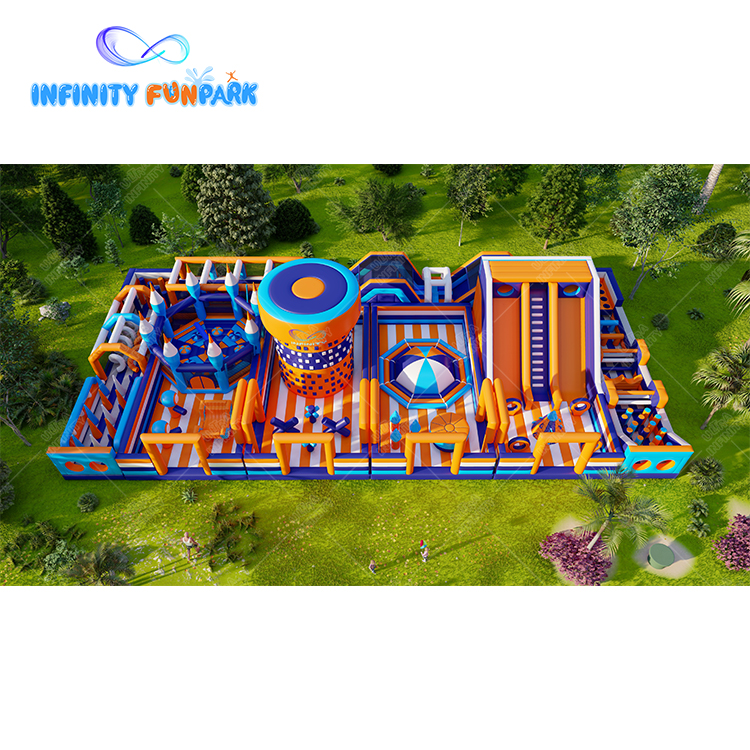
Standardized 30x14 meter commercial sci-fi playground engineered with high-profile cosmic launcher spires and high-capacity bouncing modules.

Compact 22x12 meter imperial castle design combining an interactive climbing volcano with high-velocity double slide runways.
Executive Investment Verdict: The Payback Timeline
While huge bounce houses offer undeniable visual spectacle for dedicated permanent locations, modular obstacle arenas achieve a 25–40% faster full rental payback (typically 6–9 months vs. 11–14 months). Their modular transport flexibility, lower setup payroll, broad demographic appeal, and uninterrupted rental continuity make them the premier cash-flow engine for mobile rental operators.
Ready to Scale Your Commercial Inflatable Fleet?
Work with Infinity Funpark engineers to design customized commercial obstacle parks and high-capacity inflatable attractions built to European and American safety standards.